
The Ahmedabad Points Table: A Forensic Reading of Day 1 at the Commonwealth Kabaddi Championship 2026
**मूल उत्तर:** कॉमनवेल्थ कबड्डी चैंपियनशिप 2026 के पहले दिन की पॉइंट्स टेबल जीत और स्कोर डिफरेंस पर आधारित है। इस कारण बिना खेली टीमें — नाइजीरिया, बांग्लादेश और कनाडा — मध्य क्रम में बैठी हैं। तालिका तकनीकी रूप से सही है, लेकिन भविष्यवाणी के लिए लगभग बेकार। **मुख्य तथ्य:** - ग्रुप A: श्रीलंका 48-21 (+27), भारत 46-26 (+20), युगांडा 45-29 (+16) — रैंकिंग स्कोर डिफरेंस से। - ग्रुप B: स्कॉटलैंड 59-30 ऑस्ट्रेलिया (+29), केन्या 48-28 सिंगापुर (+20)। - स्कॉटलैंड के लवप्रीत ब्रार ने एक मैच में 23 रेड पॉइंट जोड़े। - ग्रुप A में 7 और ग्रुप B में 6 टीमें; पुरुष वर्ग में कुल 13 टीमें। - दिन 1 के पाँच मैचों के कुल स्कोर: 76, 69, 89, 72 और 74। **स्रोत:** Khel Now — मेन्स पॉइंट्स टेबल, कॉमनवेल्थ कबड्डी चैंपियनशिप 2026 (अहमदाबाद), प्रकाशन: दिन 1 परिणाम रिपोर्ट। **संबंधित प्रश्न-उत्तर:** प्रश्न: दिन 1 की टेबल में नाइजीरिया चौथे स्थान पर क्यों है? उत्तर: क्योंकि रैंकिंग स्कोर डिफरेंस से तय होती है, और बिना खेली टीम का डिफरेंस शून्य होने पर वह हार चुकी टीमों से ऊपर बैठ जाती है। प्रश्न: क्या लवप्रीत ब्रार को ब्रेकआउट स्टार माना जा सकता है? उत्तर: नहीं, क्योंकि 23 रेड पॉइंट दिन की सबसे कमज़ोर बचाव-लाइन के खिलाफ एक मैच का आँकड़ा है। प्रश्न: भारत की 46-26 जीत से क्या निष्कर्ष निकलता है? उत्तर: कुछ नहीं, क्योंकि स्रोत यह नहीं बताता कि भारत ने वरिष्ठ टीम उतारी या विकासशील दल।
In the Group A points table, fourth place belongs to a team that has not yet raided once on the Ahmedabad mat. Nigeria. Below it sits England, which put 26 points on the board against India and still could not climb above it. Above it is Uganda, a 45-29 winner over Malaysia. There is no fault in the screenshot. This is exactly how the table is supposed to work — wins first, score difference as the tiebreak.
Covering kabaddi taught me early that a table is not a mirror. I still remember the evening — I was two rows from the pitch when the lights went strange. That is the day I stopped trusting my own eyes. What you see is an event; what is written down is evidence. The Day-1 tables in Groups A and B are not merely 'provisional' — they are structurally misleading, and that distortion is written in the names of three teams.
Context: thirteen teams, two groups, and a document that stays silent
The Commonwealth Kabaddi Championship 2026 is being played in Ahmedabad. Thirteen men's teams have entered — seven in Group A, six in Group B. Five matches were completed on Day 1, and the scores read as follows: Scotland 59-30 Australia, Sri Lanka 48-21 (against an opponent the source does not name), India 46-26 England, Kenya 48-28 Singapore, and Uganda 45-29 Malaysia.
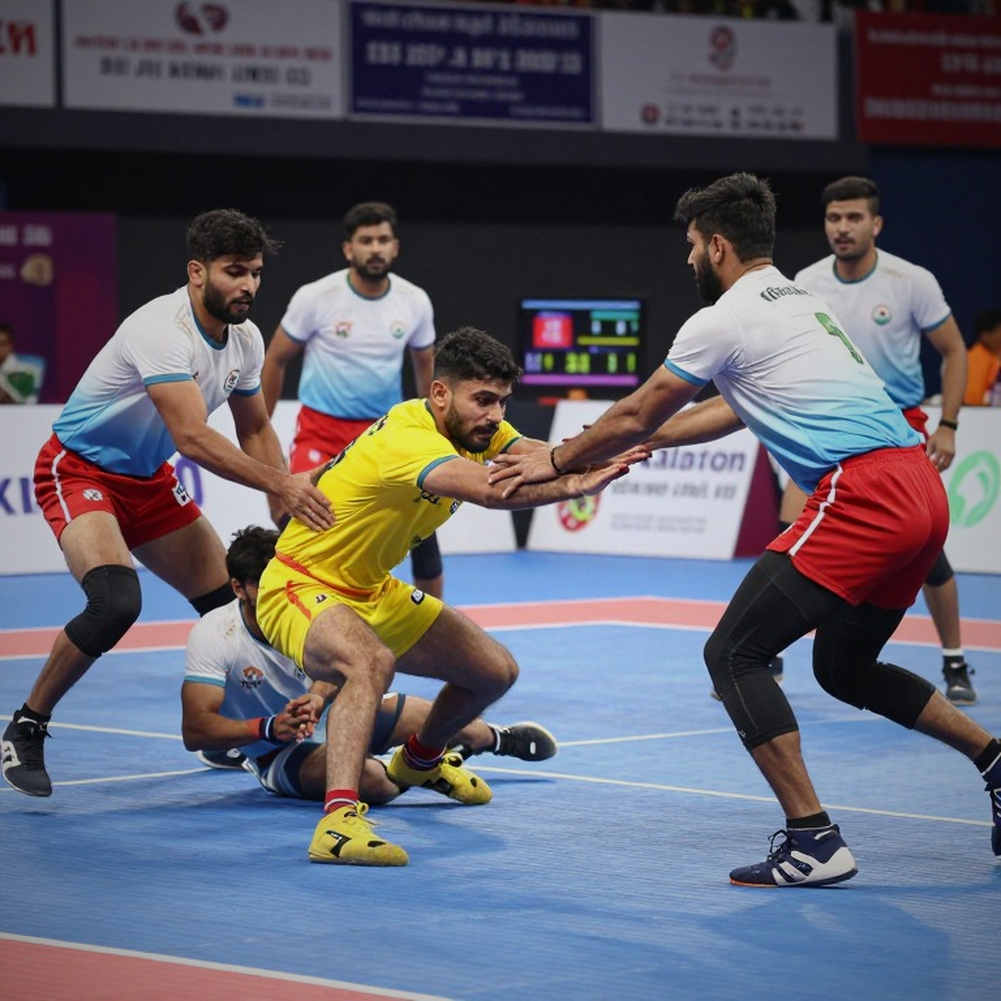
For readers who do not watch kabaddi daily, the basics must be repeated, because every injury and every scoreline in this sport comes out of these rules. Two teams of seven alternate attack and defence on a mat roughly thirteen metres long. The raider crosses into the opposition half, must touch one or more defenders and return within thirty seconds — one touch, one point. Throughout the raid he must chant 'kabaddi, kabaddi' to prove he is not taking a breath; if the chant breaks, the raid is void and the raider is out. Crossing the bonus line in the opposition half earns one point, but only when six or more defenders are on court. When all seven players of one side are ruled out, the opponent earns two bonus points and the entire eliminated team returns — the 'All Out', which is what makes kabaddi a game of fast swings. After two consecutive empty raids, the third becomes a 'Do-or-Die' raid: fail to score, and the raider himself is out.
Now to the document itself. The Khel Now Day-1 standings report contains thirty-five information points, and among them there is not a single quote, not a single tackle statistic, and not one individual statistic for any Indian player. I have read many such sheets. The report said 'minor.' The player left the mat three minutes later. That is the gap between a story filed from the stadium and a story assembled from a results feed — and recognising it is the key to this entire analysis.
Core: the arithmetic that proves itself
The good news is that the factual layer of this report is reliable. I reverse-calculated from the scorelines to reconstruct the ranking logic, and it is internally consistent.
In Group A: Sri Lanka 48-21 (+27), India 46-26 (+20), Uganda 45-29 (+16). In Group B: Scotland 59-30 (+29), Kenya 48-28 (+20). The event is running the standard rule set — win first, then score difference. As far as I can verify, there is no error. The first conclusion is this: the document is not lying — it is incomplete.
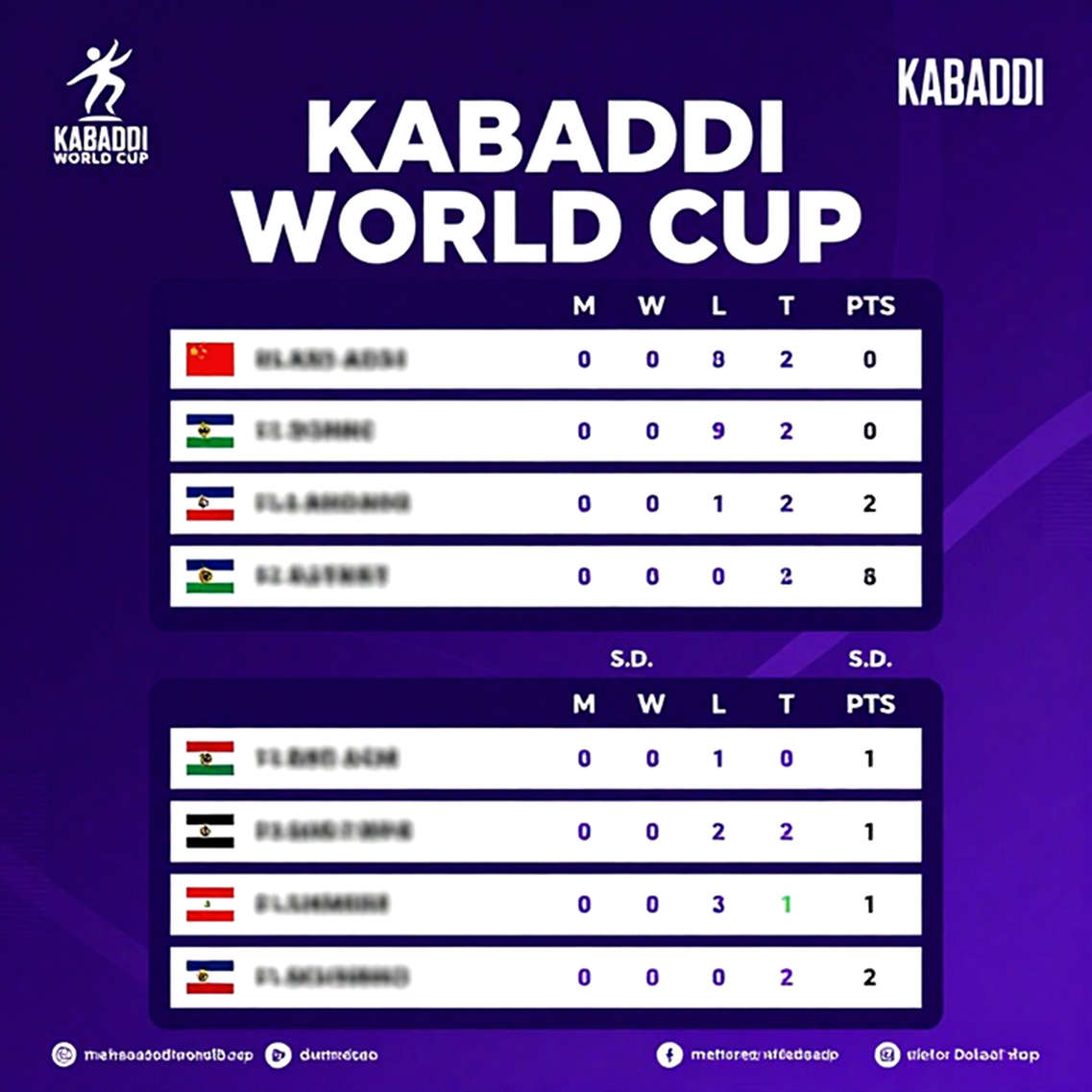
There is a more interesting by-product of the same rule, and it sits in the middle of the table. When ranking is decided by score difference, teams that have not yet played rank above teams that have already lost. In Group A, Nigeria sits fourth without having raided once. In Group B, Bangladesh is third and Canada fourth, both without playing. This is not a mistake in the report; it is a mechanical artifact of the table — and its practical meaning is that Bangladesh is in all likelihood the true strongest side in Group B, and the table is hiding it in third.
One more detail that never reaches the headlines: Group A has seven teams and Group B has six. In a round-robin, that means Group A sides play six matches and Group B sides five. The consequence runs two ways. First, cross-group comparisons of score difference become unequal — in the smaller group, one blowout can decide top spot. Second and more important: the incentive to run up the score is stronger in the smaller group. Scotland's 59-30 over Australia may be exactly that. I make this claim carefully — the source offers no tackle counts and no raid-success percentages — but unstructured defences and slow comeback rates tend to appear in matches that produce 89 combined points. Across the five Day-1 matches the totals were 76, 69, 89, 72 and 74.
Then there is the thing that kept me on this report: a single name. Scotland's Lovepreet Brar scored 23 raid points in one match. It is the only individual statistic in the entire report. That is at least 39 percent of a 59-point team total — and because team scores also include tackle points, bonus points and All Out points, his share of the raid points specifically runs well above fifty percent. Twenty-three points implies three or four Super Raids. It is an outstanding individual performance. And this is where I open my notebook.
I keep a notebook of the small flinches. That is where the real injury reports live, not in the headlines. The same rule applies to kabaddi numbers. One match, against the weakest defensive line of the day (Australia conceded 59), sits inside the noise band. In Pro Kabaddi League analytics, establishing a raider's true level takes eight to ten matches, or a full season. Calling Lovepreet Brar a 'breakout star' on the strength of one match would be premature — and that caution applies to every reading of this table.
By the same logic, the African results deserve more space than the report gave them. Kenya beat Singapore 48-28 and Uganda beat Malaysia 45-29. In the familiar story of kabaddi's 'internationalisation', African teams are usually cast as participants rather than competitors. Two African wins on one day is a small signal — the correct conclusion is 'worth tracking', not 'power shift'.
And India? India beat England 46-26. A twenty-point margin is solid but not dominant by Indian standards — Sri Lanka's margin (+27) was larger. The missing variable is squad composition. The report never states whether India fielded its senior national side or a development squad. Without that, 46-26 supports no conclusion at all — and the omission says a great deal about the editorial nature of the report.
Contrarian: 'Commonwealth' is a filter, not a description
This is where I come to the part that never rises above the bottom row of a points table. The event carries 'Commonwealth' in its name, but it is not sanctioned by the Commonwealth Games Federation, and kabaddi is not on the Commonwealth Games programme at all. The label works because a membership condition hides inside it — and that condition has excluded Iran from this edition. Iran is kabaddi's undisputed second power, the nation that broke India's men's monopoly at the Asian Games. South Korea is absent too.
None of this makes the event worthless. It means the table we are about to treat as proof of national superiority has stopped two of superiority's harshest examiners at the door. The zero written beside Iran is not on the sheet — no column shows it.
The second contrarian angle comes from the body, and that is my actual beat. 'Lovepreet Brar' is a Punjabi name, and Scotland's kabaddi ecosystem runs on the British Punjabi diaspora. That background is culturally rooted in Circle Style — a circular field, one-on-one attack and defence, as played in rural Punjab. A player raised in that tradition, arriving on the Standard Style mat, must learn seven-versus-seven positional defensive chains, bonus-line calculation, and the discipline of a thirty-second cant. I treat this as a question of drilling hours and joint load, not a style debate. When two sides meet with insufficient structured-defence preparation, an 89-point match total stops being a surprise. This is the ledger I have been writing about for twelve years — the change happens not in the rules but in the training hours.
Takeaway
An empty stadium does not protect anyone from injury. During the 2026-21 Goa bio-bubble Indian Super League I counted eleven ACL ruptures across eleven clubs — triple the normal average — and the cause was not the absence of fans but a four-week pre-season. In the same way, in a thirteen-team event like this one I am looking for a question no scoreline will answer: who holds the authority to stop play here, and who is counting these players' raids? Esports taught me that a wrist can end a career as fast as a knee — and no medical surveillance structure for this event is publicly documented.
Over the next two days, this table should be forgotten. What is worth watching is how Bangladesh plays its first match, and which vulnerable side the score-difference incentive forces into conceding sixty. The table will rewrite itself daily. The only real question is whether the people reading it will still have room to remember the name of a single raid.